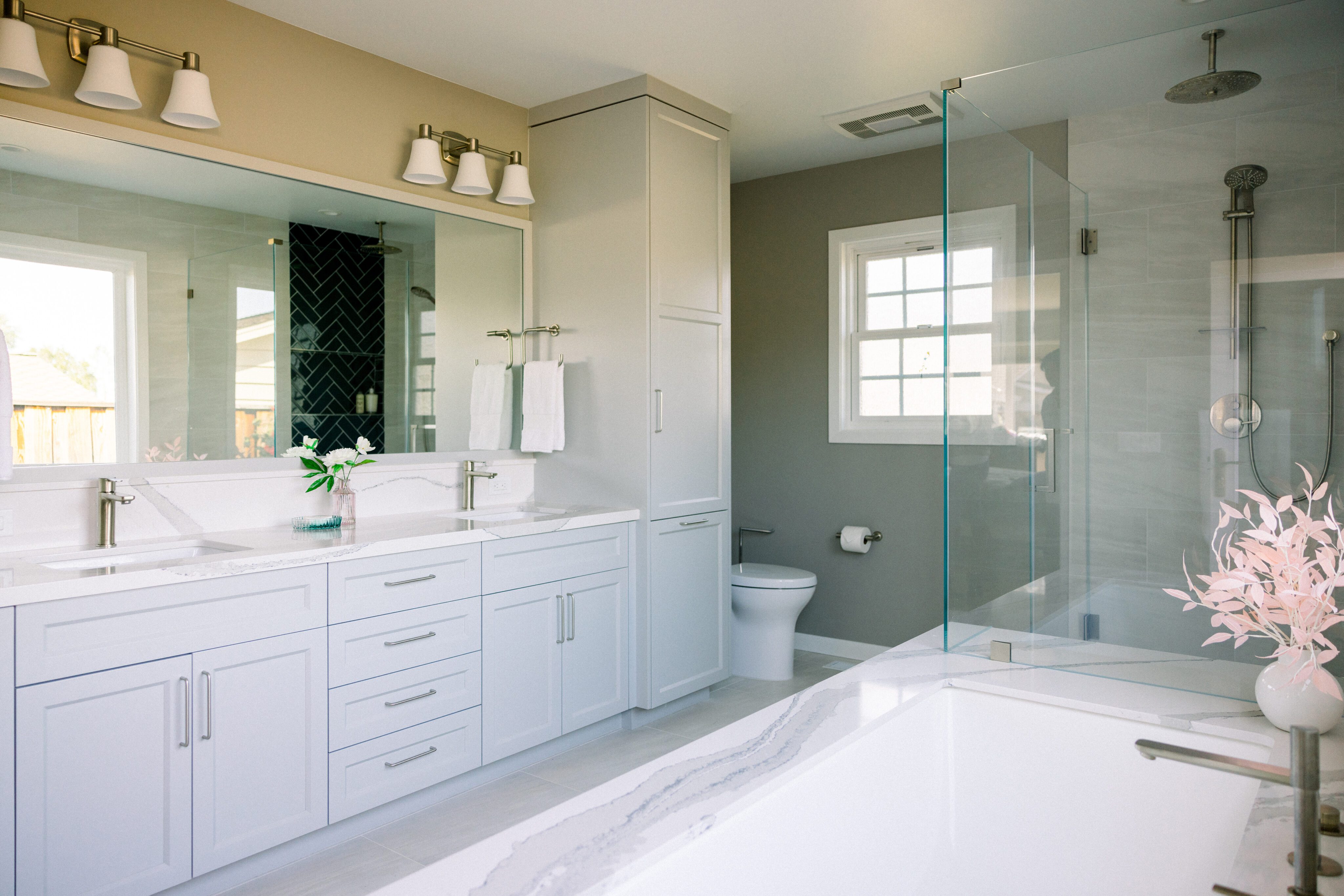

The most successful home remodels are rarely defined by a single standout finish; the marble island everyone remembers, the statement tile wall in the powder room. They’re defined by something quieter: how every material in the home relates to every other material. The quartz on the kitchen island, the tile in the guest bath, the hardware on the built-ins down the hall. When these choices are made in isolation, a home can end up feeling like a collection of good ideas that never quite agree with each other.
That’s the case for building a material moodboard before a single slab is ordered: a curated system of stone, wood, tile, and metal, selected not one at a time but for how their undertones, textures, and sheens work together across the whole home. For homeowners across San Jose, Los Altos, and the surrounding area planning a kitchen, bathroom, or whole-home remodel, this is one of the most valuable and most overlooked steps in the design process.
What Is a Material Moodboard in Interior Design?
A material moodboard is a curated collection of the actual finishes being considered for a project (stone slabs, tile samples, cabinet finishes, metal hardware, flooring) arranged together so a designer and homeowner can see how they read as a system rather than as individual selections. It’s different from an inspiration board, which is built from photos of other people’s homes. A material moodboard is built from the real materials going into your home, and its job is to answer one question: do these choices actually belong together?
The undertone is usually where a palette succeeds or fails. A white quartz with a cool gray undertone will fight with a warm white oak floor, even though both are, technically, “neutral.” A brushed brass faucet reads differently next to a warm-toned stone than it does next to a cool one. These are the kinds of relationships that are nearly impossible to judge from a single sample in a showroom, but become obvious the moment materials are placed side by side.
Starting With Anchor Materials
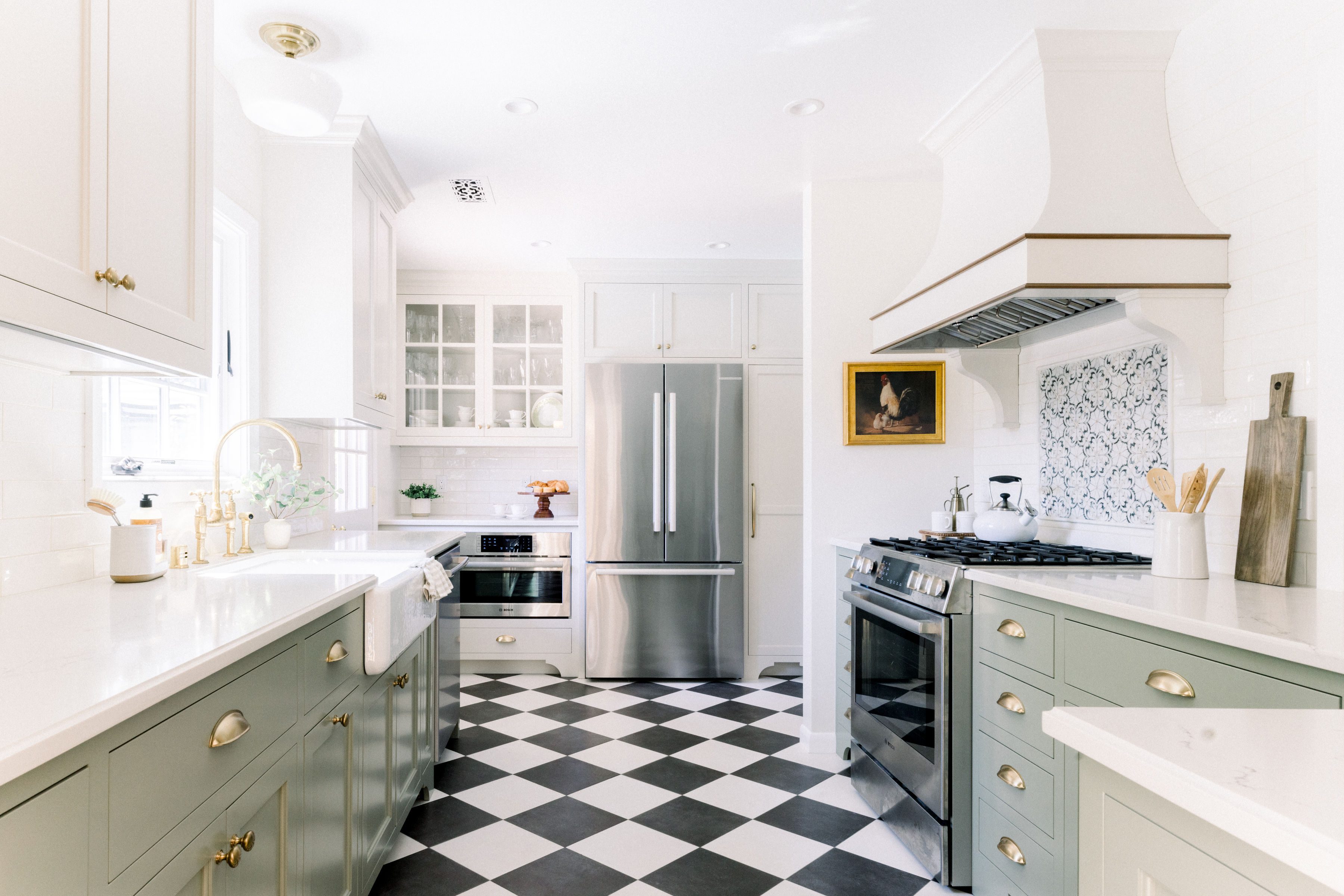
Every cohesive palette starts with an anchor, usually the largest or most visually dominant material in the space. In a kitchen, that’s often the countertop or the cabinetry. In a primary bathroom, it might be the floor tile or a slab shower surround. The anchor material sets the tone, literally, for everything that follows: its undertone, its veining or pattern, its level of formality.
In a recent kitchen we designed in Cupertino, the anchor was a quartz surface with continuous veining that ran from the waterfall island to a custom hood surround. Because that veining pattern was established first, every other decision (the cabinet color, the backsplash, the flooring) was chosen to complement its movement rather than compete with it. Starting with the anchor material and working outward, instead of picking every finish independently, is what keeps a kitchen from feeling like a showroom of unrelated good choices.
Layering In Accent Finishes Without Losing the Thread
Once an anchor material is set, accent finishes — a contrasting tile, a metal fixture, a secondary stone — get layered in to add interest without disrupting the core palette. The key is restraint: accents should reference the anchor’s undertone even when they contrast in color or texture.
We used this approach in a hall bathroom remodel in Gilroy, where a sage green limestone tile became the dominant material, chosen to match the cabinet color and create a soothing, monochromatic base. Against that quiet foundation, we layered in a tile accent band mixing onyx and marble for a pop of texture, along with oil-rubbed bronze fixtures for warmth and contrast. Each accent was chosen because it played off the limestone’s tone rather than introducing an unrelated one, which is why the space reads as intentional rather than busy.

Repeating Key Materials for Continuity Without Monotony
One of the most effective and most underused techniques in whole-home design is repetition. Carrying a single material or finish across multiple rooms creates a visual thread that ties a house together, even when each room has its own character. This doesn’t mean every room should look identical. It means a home is far more cohesive when, say, the same warm brass hardware shows up in the kitchen, the powder room, and the primary bath, or when a wood tone in the kitchen cabinetry is echoed in a floating vanity down the hall.
Repetition without monotony comes down to varying the application. The same stone might appear as a kitchen countertop and, at a smaller scale, as a bathroom vanity top. The same metal finish might show up as cabinet pulls in one room and as a light fixture in another. The material stays consistent; its role in the room changes.
Choosing Finishes That Age Well
A material palette isn’t just about how a home looks on move-in day; it’s about how it looks in ten years. Materials that age well tend to share a few qualities: they’re durable enough to handle daily use, they patina gracefully rather than showing wear as damage, and their color and pattern are timeless enough not to date quickly.
Natural stone, quality engineered quartz, solid wood, and finishes like unlacquered brass all fall into this category; they’re chosen not just for how they look now, but for how they’ll perform over decades of actual living. This is also where undertone matters again: a palette built around trend-driven colors can feel dated within a few years, while one built around well-chosen neutrals and natural materials tends to hold up regardless of what’s fashionable at the moment.
“
A material mood board is more than a collection of finishes and samples—it serves as the blueprint for a cohesive design vision across the entire project. Achieving a space that feels both timeless and thoughtfully current is a delicate balance, and a well-curated material palette is essential to that process.
By bringing colors, textures, finishes, and fixtures together in one visual composition, a material mood board ensures every selection complements the next, creating harmony from room to room. For clients who find it difficult to visualize how individual spaces will connect, seeing the materials together before they are finalized provides clarity and confidence in every design decision.
The most successful interiors are never designed one material at a time. They are thoughtfully curated as a complete story—one that reflects the client’s vision while creating a home that is cohesive, enduring, and uniquely their own.”
~Joy Allen, Design Manager, Next Stage Design + Build
How Designers Select Stone, Wood, and Tile for a Whole-Home Project
For a whole-home remodel, the process starts before any individual room is designed. A designer will typically identify one or two materials meant to appear throughout the house — a wood tone, a metal finish, a stone type — and use those as the connective tissue between rooms. From there, each room gets its own anchor and accent materials, always checked against the whole-home palette for undertone and formality.
This is also where sourcing real samples matters most. Photos and digital renderings can approximate how materials will look together, but nothing replaces holding a stone slab, a tile sample, and a cabinet finish side by side in the same light your home actually gets. It’s a step that takes more time upfront, but it’s the difference between a palette that was assembled and one that was designed.

Bringing It All Together
A remodel that feels cohesive years after it’s finished isn’t the result of luck, or of choosing the most beautiful individual materials available. It’s the result of treating the material palette as a system from the very beginning, anchored by a dominant material, layered thoughtfully with accents, repeated with intention across rooms, and chosen with an eye toward how it will hold up over time.
Next Stage Design + Build works with homeowners across San Jose, Los Altos, and the surrounding Silicon Valley communities to build material palettes that hold together beautifully, room to room and year to year. If you’re planning a kitchen, bathroom, or whole-home remodel and want help building a palette that will still feel right a decade from now, we’d love to start that conversation.